
Why Low MOQ Cornhole Programs Help Importers Test New Markets Without Freezing Cash Flow
Direct Answer
If you are importing cornhole products for a new market, a low MOQ program is one of the safest ways to test demand without tying up too much cash in inventory that may move slowly. Instead of making a large upfront commitment, you can validate pricing, packaging, buyer response, and channel fit with a smaller order. For importers, this reduces stock pressure, lowers forecast risk, and creates room to adjust designs, specifications, or sales strategy before scaling. In practical terms, low MOQ helps you buy data first and volume second.
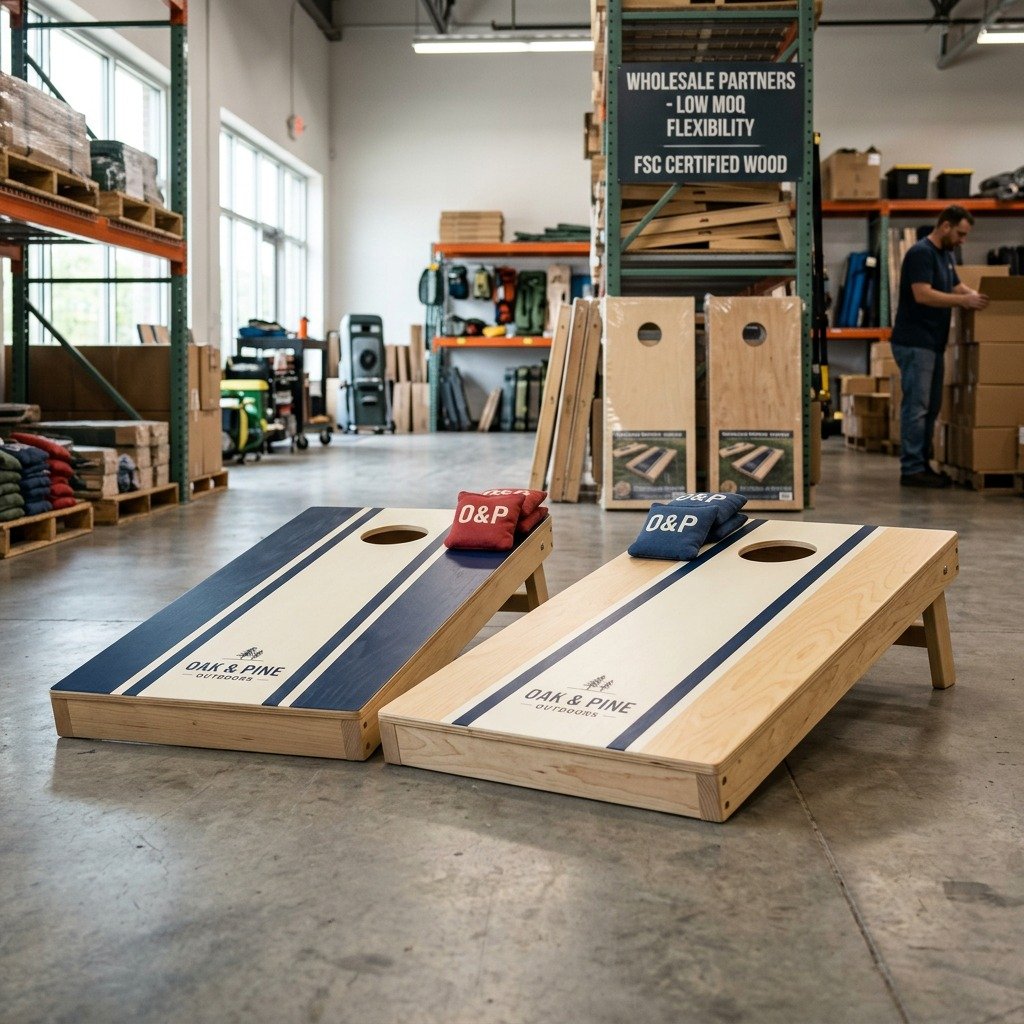
Low MOQ cornhole programs help importers launch, test, and refine new product lines with less inventory risk.
Why is high MOQ a problem when entering a new market?
For importers, the biggest risk in a new market is rarely product quality alone. It is committing too much cash before you know whether the product, price point, and sales channel will actually work.
A high MOQ forces buyers to make several decisions too early. You have to lock in specifications, packaging, branding direction, and inventory quantity before real customer feedback arrives. If the product performs below expectations, the business is left with slow-moving stock, tied-up capital, and less room to respond.
This is especially important for seasonal or trend-sensitive categories. Outdoor games, event products, retail bundles, and branded leisure sets can all perform differently depending on region, buyer profile, and merchandising strategy. A product that works well for one distributor, one country, or one retail format may need a different bundle size, color mix, or packaging style elsewhere.
High MOQ also creates operational drag. Warehousing costs rise. Reorder flexibility drops. Sales teams feel pressure to push inventory instead of learning from the market. In many cases, importers end up protecting the original purchase decision rather than making a better one.
Low MOQ changes that dynamic. It allows a buyer to enter with a controlled test batch, watch sell-through, gather channel feedback, and make the second order smarter than the first.
What makes low MOQ cornhole programs better for importers?
Low MOQ cornhole programs are not only about ordering fewer units. The real advantage is commercial flexibility.
First, low MOQ supports market validation. Importers can test whether a standard cornhole set, a branded version, or a specific packaging concept is more attractive to local distributors, retailers, resorts, or event operators. Instead of debating assumptions internally, they can let actual orders and buyer reactions shape the next move.
Second, low MOQ protects cash flow. When a company is testing a category, preserving liquidity matters. A smaller initial order leaves budget available for freight, compliance work, local promotion, sales samples, or follow-up SKUs. That matters much more than simply getting a lower unit price on a volume-heavy order that may not sell at the expected pace.
Third, low MOQ speeds product learning. Importers often discover useful adjustments only after the first batch lands in market. Packaging size may need refinement. Graphic design may need to look more premium. A carry bag may be more important than expected. Retailers may prefer a cleaner carton layout. With a lower opening commitment, these changes can happen early rather than after a large inventory mistake.
Finally, low MOQ improves channel strategy. A buyer may want to test one version for retail, one for promotional use, and one for hospitality or event rental customers. Smaller production thresholds make that type of segmented testing much more realistic.
In short, low MOQ turns sourcing into a staged decision instead of a single large bet.
High MOQ vs low MOQ cornhole programs
For most importers, the choice is not simply “cheap versus expensive.” It is “certainty versus flexibility.” The table below shows why low MOQ programs are often a stronger fit for early-stage market entry.
| Factor | High MOQ Program | Low MOQ Program |
|—|—|—|
| Upfront cash commitment | Higher and harder to recover quickly | Lower and easier to control |
| Market testing ability | Limited; too much stock arrives before feedback | Strong; easier to test region, channel, or buyer type |
| SKU flexibility | Low; harder to try multiple versions | Higher; easier to compare variants |
| Inventory pressure | Higher risk of slow-moving stock | Lower initial stock burden |
| Packaging/design adjustments | Usually delayed until later cycles | Can be refined after first test order |
| Reorder logic | Often based on original forecast | More likely based on actual sales data |
| Margin protection | Can look better on paper | Often better in practice if sell-through is healthier |
| Buyer confidence for new markets | Lower, because commitment is heavy | Higher, because risk is staged |
For importers testing a category, low MOQ usually creates a better decision path even if the first-order unit economics are not the absolute lowest possible.
What should wholesale buyers evaluate before placing a low MOQ order?
Not every low MOQ offer is equally useful. Importers should look beyond the MOQ number itself and examine whether the supplier can support repeatable business after the test phase.
The first question is consistency. If the first order succeeds, can the supplier deliver the same product standard, finish quality, branding accuracy, and packaging on larger reorders? A low MOQ test is only valuable if it leads to scalable supply.
The second question is product-market fit. Buyers should clarify whether they are testing for retail shelves, promotional gifting, hospitality use, or event channels. The right configuration may differ by market. A general-purpose test batch can work, but it is even better when the SKU logic matches the target channel.
The third question is operational readiness. Buyers should review lead time, packaging options, branding flexibility, and documentation support. Small initial orders still need reliable execution. Otherwise, the test may fail for avoidable operational reasons rather than real market weakness.
The fourth question is reorder structure. A good low MOQ program should not trap the buyer in an unscalable model. It should help the importer move from test order to repeat order with clearer pricing logic, better sales knowledge, and more confident forecasting.
Buyer Checklist
- – Does the MOQ let you test the market without straining working capital?
- – Is the product spec suitable for your target channel: retail, promotional, hospitality, or event use?
- – Can the supplier support consistent quality on future repeat orders?
- – Are branding, packaging, and labeling options flexible enough for your market?
- – Is lead time realistic for your launch window?
- – Can you compare more than one SKU or presentation format in the first cycle?
- – Do you understand landed cost, not just ex-factory pricing?
- – Is there a clear path from pilot order to scaled reorder?
A good low MOQ program should reduce risk today while making growth easier tomorrow.
Best use cases for low MOQ cornhole programs
Low MOQ programs are especially useful in a few common import scenarios.
One is distributor expansion. If you already sell outdoor leisure or promotional products, cornhole may be a logical adjacent category. A smaller opening order helps you test whether existing accounts will add it without forcing you into excess stock.
Another is retail trial. Buyers entering specialty retail, seasonal retail, or online marketplaces can use low MOQ to test packaging, price points, and sell-through before committing to deeper inventory.
A third use case is branded or private-label development. If your market responds well to branded game sets, low MOQ lets you test design direction and buyer acceptance before expanding the range.
Finally, low MOQ works well for hospitality and event channels. Resorts, activity venues, rental operators, and corporate event suppliers may want tailored sets, but demand can vary by account type. A lower initial commitment makes channel testing more disciplined and commercially safer.
FAQ
What does low MOQ mean for cornhole importers?
Low MOQ means the buyer can start with a smaller production quantity instead of committing to a large opening order. For importers, this reduces inventory risk and makes it easier to test market demand before scaling.
Why is low MOQ useful when entering a new market?
It is useful because new markets come with pricing, channel, and demand uncertainty. A low MOQ order lets buyers collect real sales feedback first, then expand based on evidence rather than forecasts alone.
Does a low MOQ program always mean a better deal?
No. The lowest MOQ is not automatically the best deal. Importers should compare quality consistency, packaging options, branding flexibility, reorder capacity, and landed cost, not just the opening quantity.
Can low MOQ help with private-label or branded programs?
Yes. It is often one of the best ways to test branded or private-label concepts. Buyers can validate design direction, packaging appeal, and customer response before committing to larger branded inventory.
What should buyers watch out for in a low MOQ offer?
They should watch for unstable quality, unclear reorder terms, weak packaging support, or a supplier that can handle small tests but not larger repeat business. A test order only works if it can lead to a reliable second stage.
Is low MOQ only for small buyers?
No. Larger importers also use low MOQ when exploring a new region, testing a new channel, or comparing multiple SKUs. It is a risk-management tool, not just a budget tool.
How does low MOQ affect cash flow?
It protects cash flow by lowering upfront inventory spend. That leaves more capital available for freight, market launch, samples, sales support, and follow-up orders based on actual demand.
When should an importer move from low MOQ to a larger order?
The right time is after the first order produces usable market evidence. If sell-through, buyer feedback, and channel response are strong, the importer can scale with more confidence and better SKU decisions.
A light next step for importers
For importers, low MOQ is most valuable when it supports a clear buying process: test the market, learn quickly, and scale only after the numbers make sense. If you are evaluating cornhole programs for retail, distribution, hospitality, or branded use, start with the order structure that gives you flexibility first and volume second. That approach usually protects both margin and cash flow better over time.