
How to Play Kubb: Rules, Court Setup, Scoring and Strategy
Kubb is a Swedish throwing game played by two teams on a small rectangular pitch. Each team tries to knock over the other side’s wooden blocks with batons, then topple the king in the middle. It is often called Viking chess, and it is one of the few lawn games that stays interesting for adults and children at the same time.
Direct Answer
You win a game of Kubb by knocking down every kubb on the opposing team’s half of the pitch, then knocking down the king. The pitch is 8 by 5 metres. Each team starts with five kubbs on its baseline. A baton that hits a baseline kubb turns that kubb into a field kubb, which the other team throws into your half for you to stand up. You must clear the field kubbs before you can attack the baseline again. Knock the king down too early, before everything else is cleared, and you lose.
What Is Kubb?
Kubb has been played on the Baltic island of Gotland for centuries, and it is now the centrepiece of lawn game programmes from Scandinavian summer houses to American rental fleets. The appeal is structural rather than decorative. Most throwing games are the same throw repeated at a fixed target. Kubb changes the target between rounds, because every kubb you knock down gets thrown back into your half as an obstacle. Your turn gets harder the better you play.
That single mechanic is why the game is used in corporate events and hospitality venues. Nobody is eliminated, everyone throws, and the last ten minutes are always close. It also explains why a cheap set is a false economy. The pieces get thrown, dropped, stood up and hit for years, and soft pine blocks lose their corners by the second season.
What Is in a Kubb Set
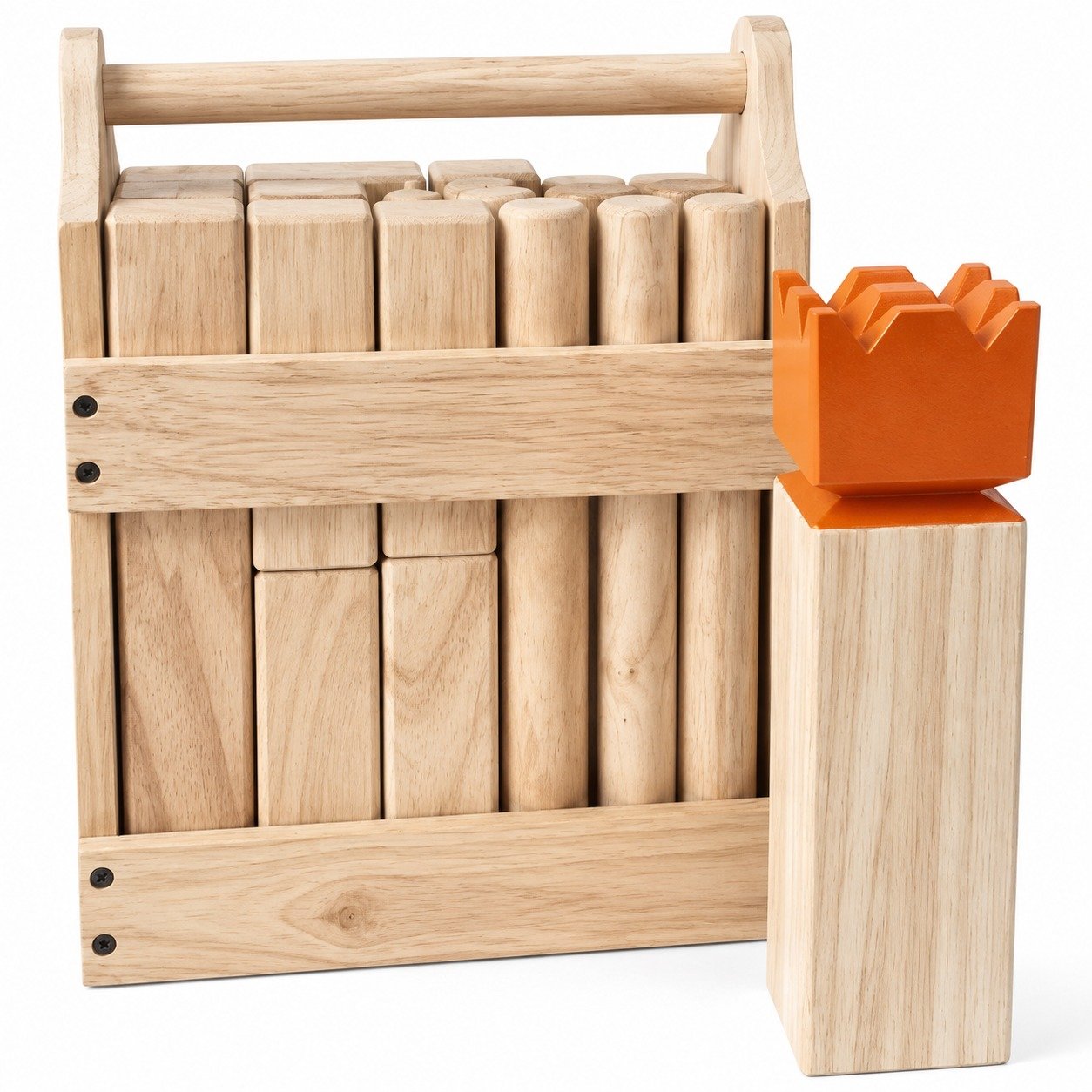
A regulation set contains four kinds of pieces. Everything else is packaging.
| Piece | Quantity | Typical size | What it does |
|---|---|---|---|
| Kubb (block) | 10 | 7 × 7 × 15 cm | Five per team on the baseline, plus any that become field kubbs |
| King | 1 | 9 × 9 × 30 cm | Sits at the centre of the pitch; knocking it down wins the game |
| Baton | 6 | About 45 cm long, 3.5 to 4 cm diameter | Thrown underarm, end over end |
| Corner stake | 4 | About 30 cm | Marks the corners of the pitch |
Competition sets add a measuring cord or a printed layout guide, and most retail sets ship with a carry bag. If you are buying for a rental fleet, the bag matters as much as the blocks: a bag that tears at the seam ends the set’s working life sooner than the wood does.
Setting Up the Court
Mark a rectangle 8 metres long and 5 metres wide. If you are working in imperial units, 26 by 16 feet is close enough for casual play. Set the four corner stakes, then place the king upright at the exact centre.
Place five kubbs in a row along each baseline, evenly spaced, with the outer kubbs roughly a block’s width inside the corner stakes. Leave the middle of the pitch clear. That empty space is where field kubbs will land, so a flat, mown surface matters more than the size of the lawn.
Surface and space
Kubb works on lawn, short grass, packed sand or artificial turf. Long grass kills the game because batons stop dead and field kubbs land unpredictably. If you are installing a permanent pitch at a venue, keep 1 metre of clear run behind each baseline so players can throw without standing in a flower bed.
How to Play Kubb, Step by Step
1. Split into two teams
Teams can be one player per side or up to six. In a six-player team, each player throws one baton per round. In a one-player team, that player throws all six. This is the main reason Kubb scales so well for events: the rules do not change when the group size does.
2. Decide who throws first
One baton is thrown at the king from the baseline. The team that lands closest to the king without knocking it over starts. Knocking the king down during this throw means the other team starts.
3. Throw end over end, underarm
The baton must be thrown underarm and must tumble end over end. A baton that lands flat and slides does not count, and a baton thrown overarm does not count. This is the only technique rule in the game, and it is the one beginners break most often.
4. Knock down baseline kubbs
Any kubb you knock over becomes a field kubb. The opposing team picks it up and throws it into your half of the pitch. It must land in bounds. If it lands out of bounds, or within one baton length of the king, it is thrown again.
5. Stand the field kubbs up
Once the field kubbs have been thrown, your team stands them upright wherever they landed. You choose the orientation that makes them hardest to hit. This is the strategic heart of the game, and it is where experienced players separate from beginners.
6. Clear field kubbs before going back to the baseline
While any field kubb is standing in your half, your batons must be aimed at field kubbs. Only when all of them are down can you attack the opposing baseline again. Miss a field kubb and the rest of the round is usually spent chipping at it.
7. Take the king
When every kubb on the opposing side is down, including their baseline blocks and any field kubbs they still had standing, you may throw at the king. Knock it over and the game ends.
The Early King Rule, and Why It Matters
If you knock the king down before the opposing team’s kubbs are all cleared, your team loses immediately. This is not a penalty or a reset; the game is over.
The rule exists to stop one lucky throw from ending a game that has not been played. It also creates the tension in the final rounds. The winning team is often the one that can clear its field kubbs calmly while the king stands there, one stray baton away from a loss.
Two practical consequences for anyone running the game at an event: brief the early king rule before the first throw, and keep a second king in the kit if you are running multiple pitches all day.
Kubb vs Molkky: Two Different Games
These two are constantly confused, including by buyers ordering stock. They share the same Nordic origin, they both involve throwing a wooden baton at wooden pieces, and they both ship in a bag with a carry handle. The rules have almost nothing in common.
| Kubb | Molkky | |
|---|---|---|
| Objective | Clear the opponent’s kubbs, then topple the king | Score exactly 50 points by knocking over numbered pins |
| Players | Two teams, one to six per side | Any number, taking turns individually |
| Pieces | 10 plain blocks plus a king | 12 numbered pins |
| Scoring | No points, the game is won or lost | Each pin is worth its number; over 50 and you drop to 25 |
| Pitch | 8 by 5 metres, marked with corner stakes | No fixed pitch, played from 3 to 4 metres |
If you are assembling a programme for a venue, the two games complement each other well. Kubb holds a group for 30 to 45 minutes and rewards attention. Molkky plays faster, suits drop-in guests, and needs no setup space. Our Kubb range and the numbered-pin sets are stocked for exactly that pairing.
Strategy That Actually Wins
Throw at the middle kubb, not the end ones
Field kubbs thrown into your half tend to cluster near the centre. Knocking out the middle baseline kubb pushes the next field kubb into open space in front of you; knocking out an end kubb pushes it into a corner where you have to stand it up anyway. The middle is the higher-value target.
Stand field kubbs in a line, not a scatter
Scattered kubbs look awkward but each one needs its own throw. A line of three kubbs can sometimes be cleared with two batons. Formations that group kubbs within one baton’s width of each other are almost always a mistake.
Do not waste batons on field kubbs at the edge of range
If a field kubb lands near your baseline, throw from a step back. If it lands near the centre line, walk up. There is no rule requiring you to throw from the baseline once field kubbs are in play.
Leave the king alone until it is legal
Every experienced player has seen a team lose by clipping the king while trying to clear a field kubb next to it. If a field kubb lands close to the king, stand it up facing away from your throwing line, and aim low.
Six Mistakes Beginners Make
- Throwing overarm. It feels natural and it is illegal. Underarm, end over end.
- Not standing field kubbs up straight away. They must be standing before you throw at them again.
- Forgetting to clear field kubbs. Batons aimed at the baseline while field kubbs are standing do not count.
- Grouping field kubbs together. Stand them apart to force separate throws for the other team.
- Hitting the king early. Instant loss. Brief it before the first throw, every time.
- Playing on long grass. Batons stop dead and field kubbs land unpredictably. Mow first.
Buying Notes for Wholesale and Rental Buyers
Kubb is one of the easier games to buy badly. The blocks all look the same in a photograph, and the difference only shows up in the second season, when the corners have rounded off and the batons have split.
Three things to check before you place an order:
- Wood species and moisture content. Rubberwood and dense hardwood hold their edges. Soft pine dents, and a dented kubb does not stand up straight, which changes the game. Kiln-dried stock also resists the splitting that shows up after a wet winter in a storage container.
- Corner treatment. Sharp corners chip. A light chamfer keeps the block looking new longer and costs almost nothing at the factory.
- Bag and crate construction. For rental fleets, the packaging fails before the wood does. Heavy canvas with bar-tacked seams or a solid wood crate both work; a single-stitch nylon bag does not.
Our own range covers both ends of that spectrum: a tournament rubberwood set for venues that need consistent tournament dimensions, and a regulation set in a wooden box for retail and hospitality programmes where the packaging is part of the sale. Everything is made in our own factory in Yunhe, Zhejiang, with your artwork, logo and packaging from 100 sets. See the full Kubb range or read how our custom programme works.
FAQ
How many people can play Kubb?
Two teams of one to six players. A six-player team throws six batons per round, one per player. A solo player throws all six.
How big is a Kubb pitch?
Eight metres by five metres, with the king at the centre and five kubbs on each baseline. Twenty-six by sixteen feet is close enough for casual play.
What happens if I knock the king down early?
Your team loses immediately. The king can only be attacked once every kubb on the opposing side has been knocked down.
Can I throw from anywhere?
Baseline kubbs must be attacked from behind your own baseline. Once field kubbs are in play you may move forward, as long as you stay behind the kubb you are aiming at.
Is Kubb the same as Viking chess?
Yes. Viking chess is the common English nickname for Kubb. The games are identical.
How long does a game take?
Twenty to forty minutes for two teams of two to four. Six-a-side games run longer because more batons are in play each round.
What wood should a Kubb set be made from?
Rubberwood, beech or dense hardwood. Soft pine dents at the corners, and a dented kubb does not stand straight, which changes how the game plays.
Can I order Kubb sets with my own branding?
Yes. Our factory prints or laser-engraves logos on the king and blocks, and prints the carry bag, from 100 sets per style. Artwork proofing takes 24 hours and physical samples ship in three to seven days.
CTA
If you are sourcing Kubb sets for retail, rental or a hospitality programme, we build them in our own factory with your artwork and packaging from 100 sets. Send your quantity and target price and we will come back with cost, lead time and a free mockup within 24 hours.