
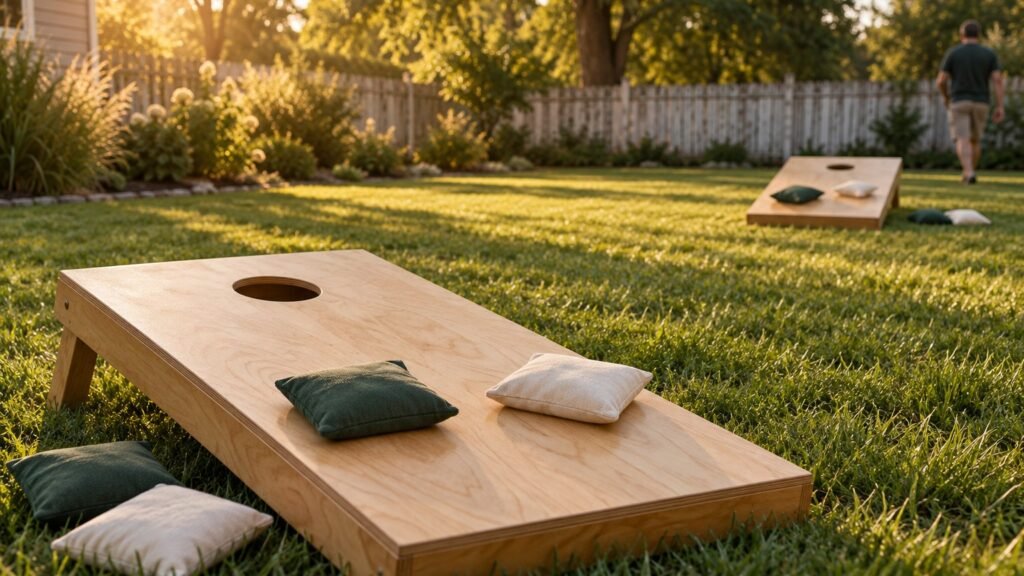
Cornhole Board Dimensions: 4×2, 3×2, 31-Inch and Which Fits Your Setup
Three sizes get called “cornhole board” in the same conversation, and they are not interchangeable. A 4 x 2 ft board is what US leagues measure. A 3 x 2 ft board is what fits in a trunk. A 31-inch board is what a tailgate buyer actually wants at 7 a.m. in a stadium lot.
This page gives you the regulation numbers, the tolerances that matter, and the point where a smaller board stops being cornhole and starts being a different game.
Direct Answer
A regulation cornhole board has a 48 x 24 in (4 x 2 ft) playing surface, a 6 in diameter hole centered 9 in from the rear edge and 12 in from either side, and a rear edge standing 12 in off the ground. The hole to hole distance between two boards is 33 ft, which puts the front edges 27 ft apart. Anything smaller than 4 x 2 ft is a tailgate or portable board, not a regulation board.
The five measurements that actually matter
| Measurement | Regulation | What it controls |
|---|---|---|
| Playing surface | 48 x 24 in | How much runway a bag has to slide before the hole |
| Hole diameter | 6 in | Difficulty. A 5 in hole raises the miss rate sharply |
| Hole position | 9 in from rear edge, 12 in from either side | Whether a blocked shot can still drop, and how the board rebounds |
| Rear height | 12 in | The angle of the surface, which sets slide speed and bounce |
| Top thickness | 1/2 in (12 mm) minimum | Sound, bounce, and how long the board stays flat |
Every other number you see quoted online is derived from these five. Front height, for example, is not a separate rule. On a 48 in board with a 12 in rear edge, the front edge lands roughly 3 to 4 in off the ground, and that is a consequence of the rear height and the board length, not an independent specification.
4 x 2 ft: the size leagues measure
If a buyer says regulation, they mean 48 x 24 in. It is the size printed in the rule books US leagues play by, and it is the size that shows up in every tournament photo because it is the only size that plays the same way twice.
The 48 in length is doing real work. A bag that lands 6 in past the hole on a 4 x 2 board still has room to settle. On a shorter board the same throw hits the back rail and drops off the front. That is why competitive play stays at 48 in even though the board is awkward to carry.
Our professional cornhole boards and the rest of the regulation board range are built at 120 x 60 cm per board, which is 47.2 x 23.6 in. This is the metric equivalent most export factories cut to, and it is what our tooling is set for. If your league or your retail listing measures strictly at 48 x 24 in, say so on the purchase order and we cut imperial instead. The difference is 0.8 in on the length and it matters to a tournament buyer, so it should never be left to assumption.
3 x 2 ft: the tailgate size, and what you give up
A 3 x 2 ft board keeps the 24 in width and cuts 12 in off the length. Width is what keeps the hole centered and the bag from running off the side, so leaving it alone is the right call. Length is what you sacrifice.
What changes in play: the bag reaches the hole sooner, so the slide phase is shorter and the board feels faster. Bounce off the top edge becomes more punishing because there is less surface behind the hole to catch a hard throw. For a stadium lot or a rental fleet, none of that matters. For a league, it does.
The 3 x 2 board also solves a logistics problem that rarely gets mentioned in size guides. Two 4 x 2 boards need 123 cm of carton length. Two 3 x 2 boards fit across the back seat of most sedans without folding the rear bench.
31-inch boards: the trunk-friendly size
Below 3 x 2 ft the boards are usually described by length rather than by feet. Our 31-inch line runs 31.5 x 15.7 x 2.0 in per board, stands 9.8 in at the rear, and uses a 10 cm center panel between the legs. It is a genuinely different product from a regulation board, and it should be merchandised that way.
Two things stay constant no matter how small the board gets. The bag is still 6 x 6 in, and the hole stays at 6 in diameter. Shrinking the hole on a small board turns a casual game into a frustrating one, because the bag no longer fits the target with any margin. If a supplier quotes you a 4 in hole on a 31-inch board, they have optimized for material cost, not for play.
Side by side: the two ends of the range
These are the published specs on our own boards, one regulation and one 31-inch, so you can see exactly which numbers move when the board shrinks.
| Spec | 4 x 2 regulation | 31-inch |
|---|---|---|
| Board size per board | 47.2 x 23.6 x 3.0 in (120 x 60 x 7.5 cm) | 31.5 x 15.7 x 2.0 in (80 x 40 x 5 cm) |
| Rear height, legs open | 12 in (30.5 cm) | 9.8 in (25 cm) |
| Hole | 6 in, centered 9 in from rear edge and 12 in from either side | 6 in |
| Center panel between legs | 4.7 in (12 cm) | 3.9 in (10 cm) |
| Top | 18 mm birch plywood | 15 mm birch plywood |
| Frame and legs | 20 mm, two rear support braces | 15 mm, clean back, no cross brace |
| Two-board carton | 123 x 17 x 63 cm, 21.7 kg gross | Smaller carton, lighter set |
| Container load, 40HQ | 516 sets | Higher, smaller carton |
| Typical buyer | League, tournament, rental fleet | Gift, tailgate, trunk space |
The 3 x 2 ft tailgate board sits between these two. It keeps the 24 in width of a regulation board and drops to 36 in of length, so it still holds a centered 6 in hole with playable room behind it. If a size is not on this page, ask for the spec sheet rather than assuming it matches a bigger board.
Thickness: 12 mm, 15 mm, 18 mm, 20 mm
Thickness is the specification buyers ask about last and complain about first. It changes three things.
- 12 mm is the budget tier. Light, loud, and it will bow in the middle after a season of outdoor storage unless the frame is braced.
- 15 mm is the portable tier. Fine for tailgate boards where the whole point is that one person can carry a set.
- 18 mm is the workhorse. It is the thickness most tournament boards are built from, and it holds a flat surface through humidity swings if the frame is right.
- 20 mm is the frame and leg spec on our professional line, with an 18 mm top, 20 mm frame, 20 mm legs, and a 12 mm center panel. The heavier frame is what stops the bounce from changing after a hundred games.
Thickness alone does not decide quality. A 12 mm top on a braced 20 mm frame plays flatter than an 18 mm top on an unbraced frame. When you compare quotes, compare the frame section and the bracing before the top thickness.
Hole placement and tolerance
The hole is 6 in across, 9 in from the rear edge, and 12 in from either side. Those numbers put the hole on the center line and leave 9 in of board behind it, which is the zone that catches hard shots and drops them in.
What a spec sheet usually leaves out is tolerance. A hole punched 1/4 in off center is visible to a player within two throws, because the board stops rebounding symmetrically. Commercial tolerance on hole position is typically plus or minus 1/8 in. Ask for it in writing, and ask for the hole edge to be sanded and sealed. A raw plywood hole edge eats bag seams, and bag replacement is the first cost a rental operator notices.
Our own boards are cut with the hole centered 9 in from the rear edge and 12 in from either side, measured after the frame is assembled rather than before, because clamping during assembly moves the panel by a millimeter or two.
How far apart do the boards go
Regulation play sets the front edges 27 ft apart, which puts the holes 33 ft apart. Both numbers describe the same setup from different reference points, and mixing them up is the most common source of a court that feels wrong.
Front edge to front edge is the number to measure on site, because it is the one you can find with a tape without guessing where the board center is. Our cornhole accessories range includes a 27 ft distance cord for exactly this reason: rental crews set up dozens of courts a week and a cord removes the argument.
Backyard players routinely shorten the distance. Nothing breaks, but the game changes: shorter distance means flatter throws, fewer bounces, and higher scores. If you are laying out a venue, mark 27 ft and leave it alone.
Bag size is tied to board size
The bag is 6 x 6 in and weighs 15 to 16 oz in regulation play. That is not an independent choice: a 6 in bag against a 6 in hole is the difficulty the game is built around. Change either one and you have changed the sport.
This is why the small-board question has an obvious answer. Keep the hole at 6 in and accept that a 31-inch board plays harder, or shrink the hole and produce a board that casual buyers will abandon. We build the first kind. Our cornhole bags are 6 x 6 in, available with corn fill or synthetic fill, and the fill choice changes slide and break-in more than most buyers expect.
What this means if you are ordering boards
Size decisions turn into freight decisions fast. A regulation set packs two boards into a 123 x 17 x 63 cm carton at 21.7 kg gross. That carton loads 213 sets in a 20GP, 410 in a 40GP, and 516 in a 40HQ. Drop to a tailgate board and the carton shrinks, so a container carries more sets at a lower unit price, which is the real reason tailgate sizes dominate promotional programs.
Minimum order on our board line is 100 sets, including your own artwork and packaging. Sampling runs a free digital mockup in 24 hours with a physical sample in 5 days, and production takes 20 to 30 days after artwork sign-off. If you are building a program around a specific size, put the size, the tolerance, and the target market on the brief, because a 47.2 in board and a 48 in board are the same product in a photo and different products in a league protest.
Start from the board range, pair it with a regulation size complete set or browse all 82 products, or read the custom program for artwork and packaging options. Factory capacity, testing, and audit details live on our manufacturing page.
FAQ
Is a 3 x 2 cornhole board regulation size?
No. Regulation is 48 x 24 in. A 3 x 2 ft board is 12 in shorter, so bags reach the hole sooner and the board plays faster. It is a legitimate tailgate and retail size, but it will not pass a league measurement.
What size hole does a cornhole board have?
6 in in diameter, centered 9 in from the rear edge and 12 in from either side. The hole stays 6 in on smaller boards too, because regulation bags are 6 x 6 in and the difficulty depends on that ratio.
How thick should a cornhole board be?
Half an inch, or 12 mm, is the usual minimum. Most tournament boards use 18 mm tops in a 20 mm frame, which holds a flat surface through humidity changes. Tailgate boards commonly use 15 mm to keep the set light.
How far apart are cornhole boards?
27 ft from the front edge of one board to the front edge of the other, which equals 33 ft between hole centers. Measure front edge to front edge on site, it is the easier reference to find with a tape.
Do 31-inch boards use a smaller hole?
They should not. A smaller hole on a shorter board makes the game frustrating rather than compact. Ask any supplier to confirm the hole diameter and the hole position on the spec sheet before you approve a sample.