Commercial Cornhole After-Sales Control: Why Replaceable Parts Matter More Than Lower Unit Price
Direct Answer
For B2B cornhole buyers, the cheapest board per unit often becomes the most expensive board over a season. Boards with replaceable parts — deck panels, frame joints, leg caps, and surface coatings — cut after-sales costs by 30–50% compared to sealed one-piece designs. Modular construction reduces return shipping, eliminates full-unit replacements, and keeps retail and rental customers operational without downtime. When evaluating suppliers, prioritize part-level serviceability over headline unit price.
Modular cornhole boards with replaceable parts reduce long-term after-sales costs.
Why After-Sales Cost Is the Hidden Margin Killer
Wholesale buyers focus on FOB price. That is a mistake.
A $19 board that cracks after 40 games costs more than a $25 board that lasts 400 games and lets you swap the damaged deck for $4. The math is not complicated, but most importers do not run it.
Here is what actually drives after-sales cost in the cornhole business:
Return shipping: A damaged board shipped back from a US warehouse costs $15–$40 in domestic freight alone. A replacement deck panel ships for $3–$6.
Warranty claims: Retail partners deduct warranty costs from future orders. One wave of defects can wipe out your margin on an entire container.
Reputation damage: Amazon reviews do not distinguish between “bad product” and “unservicable product.” A board you could have fixed becomes a permanent one-star review.
Inventory bloat: Without replaceable parts, every damaged unit becomes dead stock. With modular parts, you carry a small bag of spares instead of a pallet of full replacements.
The suppliers offering the lowest unit price are usually the ones with the least serviceable designs. They cut costs by eliminating part-level access — sealed frames, glued joints, non-replaceable leg caps. When something breaks, the entire unit is garbage.
What Makes Modular Cornhole Boards Different
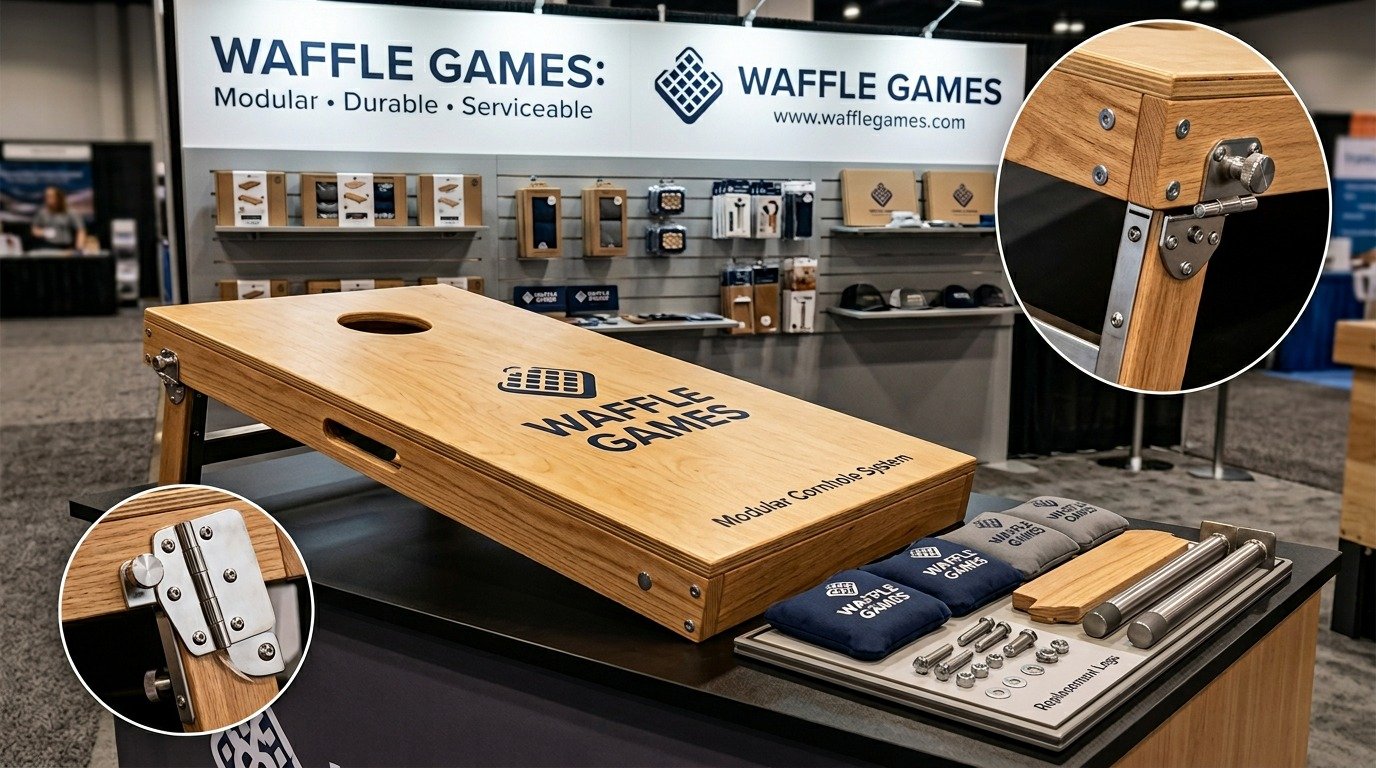
Modular cornhole boards are designed so that individual components can be removed and replaced without specialized tools or factory involvement.
Key serviceable parts in a well-designed modular board:
Deck panel: The playing surface. Cracks, warps, or graphic wear can be addressed by swapping the panel rather than the whole frame. Look for screw-mounted or clip-locked deck panels, not glued.
Frame joints: Foldable or bolted frame connections that can be tightened or replaced. Avoid welded-only frames — one broken weld means the entire frame is scrap.
Leg caps and feet: The most common wear point on rental and event boards. Replaceable rubber or plastic caps cost pennies and prevent frame damage from ground contact.
Surface coating: Screen-printed graphics wear off. Boards with replaceable vinyl overlays or recoatable surfaces extend usable life by 2–3x.
A modular design adds $2–$5 to the unit cost. It saves $15–$40 per incident in avoided returns and replacements.
Sealed Design vs Modular Design: Cost Comparison
The table below compares total cost of ownership between a standard sealed cornhole board and a modular board with replaceable parts over 300 games of heavy use:
What Wholesale Buyers Should Look For Before Ordering
Not every board marketed as “modular” actually has serviceable parts. Here is a practical checklist:
Ask for a parts diagram. If the supplier cannot show you individual part numbers and exploded-view drawings, the board is not truly modular.
Request replacement part pricing upfront. A supplier that charges $12 for a $4 deck panel is not giving you after-sales savings.
Test the swap process. Can a store employee swap a deck panel in under 5 minutes with basic tools? If not, your retail partner will still call it “broken.”
Check leg cap availability. This is the single most-replaced part. If the supplier does not stock them separately, walk away.
Verify frame joint type. Bolted > clipped > welded. Bolted joints can be tightened on-site. Welded joints cannot.
Ask about surface recoating. Some suppliers offer factory recoating services for worn decks, extending board life without full replacement.
Best Use Cases for Modular Cornhole Boards
Modular boards make financial sense in specific scenarios:
Rental companies: The #1 use case. Rental boards take abuse constantly. Swapping parts on-site means zero downtime and no return shipping.
Retail displays and demo units: Floor models wear fast. Replaceable deck panels let you refresh the display without buying new inventory.
Event organizers: Corporate events, festivals, and tailgate parties generate wear. Modular boards let you service between events instead of replacing after each season.
Amazon and DTC sellers: Warranty claims are the biggest cost driver on Amazon. Modular parts let you resolve claims by shipping a $4 panel instead of a $22 full unit.
Promotional and custom-branded orders: Clients reorder graphics, not boards. A replaceable graphic overlay lets you upsell rebranding without a new board order.
Buyer Checklist: How to Choose the Right Modular Cornhole Supplier
Before placing a wholesale order, confirm the following:
[ ] Supplier provides a parts catalog with individual SKUs for every replaceable component
[ ] Deck panels are screw-mounted or clip-locked, not glued or riveted
[ ] Frame joints are bolted or tool-free foldable, not welded-only
[ ] Leg caps and feet are available as separate orderable parts
[ ] Replacement parts ship within 5 business days from US or China stock
[ ] Supplier offers a per-part pricing list, not just full-unit pricing
[ ] Sample order includes at least one part swap demonstration
[ ] Warranty terms specify part-level coverage, not just full-unit replacement
If a supplier cannot check at least 6 of these 8 boxes, their “modular” claim is marketing, not engineering.
FAQ
Q: How much does a replacement deck panel typically cost?
For wholesale orders, expect $3–$8 per deck panel depending on material and graphic complexity. This is 15–30% of the full board cost.
Q: Can end customers swap parts themselves without professional help?
Yes, if the board uses tool-free or basic-tool connections. Screw-mounted decks and bolted frames can be serviced by anyone with a Phillips screwdriver. Avoid designs requiring proprietary tools.
Q: Do modular boards weigh more than sealed boards?
Slightly — typically 0.5–1 lb heavier due to fastening hardware. This is negligible for transport and storage, and the serviceability benefit far outweighs the weight difference.
Q: What is the most common part that needs replacement?
Leg caps and feet, followed by deck panels. Leg caps wear from ground contact on hard surfaces. Deck panels crack or warp from moisture and heavy impact.
Q: Will modular boards void any certifications or safety standards?
No. Modular construction does not affect UL, ASTM, or consumer safety compliance as long as the assembled unit meets the same dimensional and stability requirements.