
How to Play Cornhole: Rules, Court Setup and Scoring
Cornhole is a bag toss game played between two angled boards. Players take turns pitching fabric bags underhand at the far board, scoring one point for a bag that stays on the board and three points for a bag through the hole. This guide covers the official rules in plain language, and adds notes for rental companies, venues and retailers who need to explain the game to their own customers.
Direct Answer
To play cornhole, set two boards so their front edges are 27 feet apart. Each player or team has four bags. Players alternate throws from beside one board toward the other until all eight bags are thrown, which completes one inning. A bag on the board scores 1 point and a bag through the hole scores 3 points. Under cancellation scoring, only the difference between the two sides counts each inning. The first side to reach 21 points at the end of an inning wins.
What You Need
| Item | Regulation reference | Where to find it |
|---|---|---|
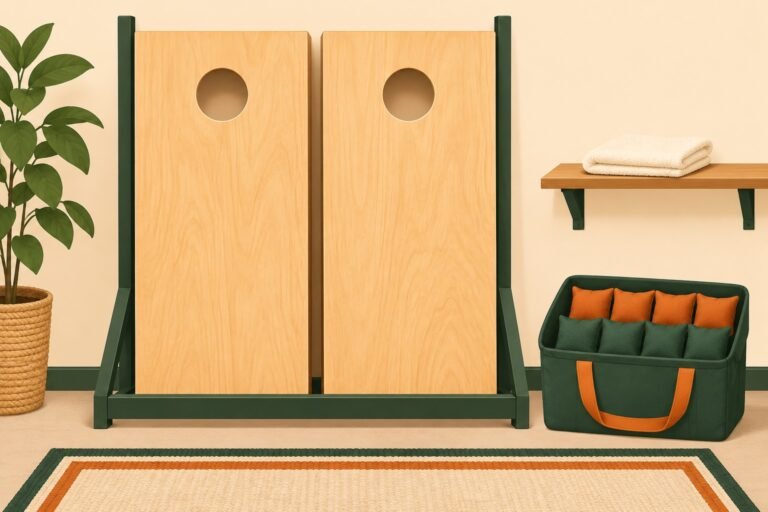
| 2 boards | 48 × 24 in playing surface, 6 in hole centered 9 in from the top edge | Cornhole boards |
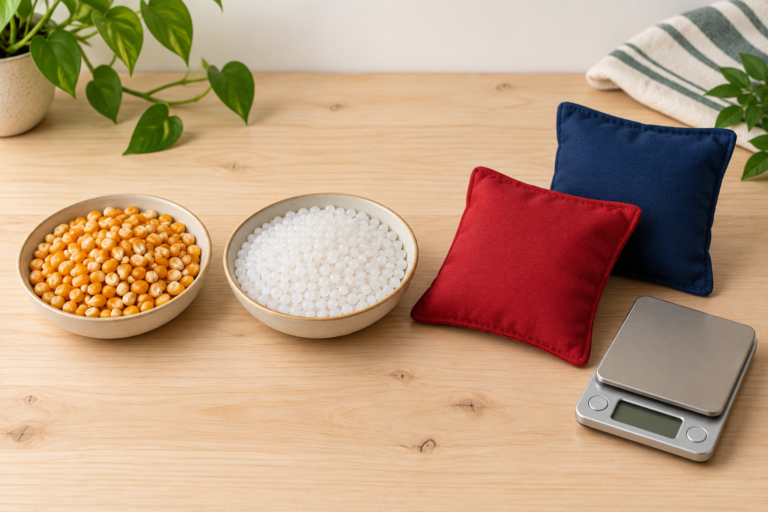
| 8 bags | 4 per side in two colors, about 6 × 6 in, 14 to 16 oz (ACA) or 15.5 to 16.5 oz (ACL) | Cornhole bags |
| Distance marker | 27 ft between the front edges of the boards | Cornhole distance cord |
| Score keeping | Running total to 21 | Cornhole scoreboard |
Most buyers source boards and bags together as a complete cornhole set, so colors, bag weight and packaging match from the start. For full measurements, see our cornhole board dimensions guide.
Setting Up the Court
- Find a flat area. The American Cornhole Association (ACA) describes a court about 8 to 10 feet wide and at least 40 to 45 feet long. Casual games work on any level lawn, patio or event floor with that much room.
- Place the boards facing each other. Line them up so the holes sit on the same line, with the front (low) edges facing each other.
- Measure 27 feet between the front edges. This is the regulation distance for adults. For younger players, ACA guidance suggests a shorter distance of around 12 to 15 feet.
- Mark the pitcher’s boxes. Each board has a pitcher’s box on either side of it, about 4 feet by 3 feet. The front edge of the board is the foul line.
Basic Rules of Play
Singles and doubles
In singles, both players stand at the same end, one on each side of the board, and throw at the opposite board. They walk to the other end after each inning. In doubles, each team splits up: one partner at each end. Partners at the same end throw against each other, so nobody has to walk between innings.
Throwing
- All throws are underhand.
- Players alternate one bag at a time until each has thrown four bags.
- Stay inside your pitcher’s box and behind the foul line when the bag leaves your hand.
- Under ACA rules, a player has 20 seconds to throw.
- The side that scored in the previous inning throws first in the next one.
Common fouls
A fouled bag is removed and does not score. Typical fouls include stepping past the front edge of the board, throwing from outside the pitcher’s box, a bag that hits the ground before landing on the board, and going over the time limit.
How Scoring Works
| Result | Points | Notes |
|---|---|---|
| Bag through the hole | 3 | Also counts if a bag on the board is knocked in by another bag |
| Bag resting on the board | 1 | The bag must not be touching the ground |
| Bag off the board or fouled | 0 | Remove fouled bags before the next throw |
Cancellation scoring: At the end of each inning, subtract the lower score from the higher one. Only the difference is added to the leading side. For example, if Team A scores 5 and Team B scores 3, Team A adds 2 points and Team B adds nothing. The game ends when one side reaches 21 points at the end of an inning.
Many casual players use straight scoring instead, where both sides keep all their points. If you run events, pick one system and print it on the scoreboard or rules card so every group plays the same way.
ACA and ACL Rules: What Differs
The two main US rule bodies agree on the basics: 2 × 4 ft boards, a 6 in hole, 27 ft between board fronts and 21 points to win. The differences matter mostly for sanctioned play.
- Bags: ACA lists 14 to 16 oz bags. The American Cornhole League (ACL) specifies 6 × 6 in bags at 15.5 to 16.5 oz.
- Hole tolerance: ACL allows a tighter tolerance on the hole diameter than ACA.
- Board approval: ACL rules for the 2026/2027 season require stamped boards at State level events and above from October 1, 2026.
For backyard play, rental fleets and corporate events, either rule set works. If your customers enter sanctioned tournaments, confirm which body runs the event before choosing boards and bags. Our cornhole bag filling guide explains how corn and resin fill affect weight and play.
Sources: ACA official rules and ACL rules and regulations 2026/2027.
Running Cornhole for Rental Fleets, Venues and Events
If you rent, resell or host cornhole, the rules above are what your customers need to hear in 30 seconds. A few practical points help sets last and keep games moving.
- Include a rules card. A printed card or board graphic with the 1 point and 3 point rule, the 27 ft distance and the 21 point target answers most guest questions. Artwork printed on boards and bags is part of our custom program, so rules and branding can be designed together.
- Use a fixed distance cord. Staff can set up identical courts in minutes without a tape measure.
- Choose bag fill for the setting. Resin filled bags suit outdoor and rental use because they handle damp grass better than corn. Double sided bags give experienced players two slide speeds, cotton canvas on one side and suede on the other.
- Match board size to space. Full regulation sets suit lawns and tournaments. Tailgate size boards at 3 × 2 ft fit patios, bars and car boots.
- Plan for storage and transport. A carrying case protects board faces between bookings.
- Add lighting for evening events. Cornhole board lights keep play going after dark.
More segment guides: outdoor games for rental businesses, outdoor games for bars and giant games for events.
Sourcing Cornhole Sets for Your Business
Waffle Games manufactures cornhole boards, bags and complete sets for importers, retailers and rental companies. Most programs start at 100 sets, with a free digital mockup within 24 hours. See the wholesale buying guide for the ordering process, or read our FAQ. To discuss a project, request a quote.
Frequently Asked Questions
How far apart are cornhole boards?
Regulation play uses 27 feet between the front edges of the two boards. For children, a distance of about 12 to 15 feet is common.
How many points do you need to win cornhole?
The first side to reach 21 points at the end of an inning wins. With cancellation scoring, only the points difference in each inning counts.
How much is a bag in the hole worth?
A bag that goes through the hole scores 3 points. A bag that stays on the board scores 1 point.
Do you throw cornhole bags underhand?
Yes. Official rules require an underhand throw from inside the pitcher’s box, without stepping past the front edge of the board.
Who throws first in cornhole?
A coin toss usually decides the first inning. After that, the side that scored in the previous inning throws first.