Cornhole Board Care and Winter Storage for Rental and Hotel Teams
Clean according to the actual finish, dry equipment before packing, and store wooden cornhole boards indoors in a suitable dry location. For a commercial fleet, add a return inspection and a release check before the next booking. A protective bag or clear coating does not establish permanent outdoor-storage suitability. Keep the instructions for each board and bag configuration with the equipment rather than applying one cleaning method to every set.
What should staff check when cornhole equipment comes back?
Start cornhole board care with a return check that separates ordinary cleaning from damage requiring a decision. Waffle Games rental and hotel buyers can use a simple equipment record showing the product, set contents, finish and last accepted condition. Check the playing face, hole edge, frame, legs and hardware before sending the equipment to its storage location. Compare the returned set with its own record rather than another model’s photograph. A staff member should be able to identify missing components, visible damage and items still needing attention without guessing which accessories were originally supplied. This is an operating checklist to adapt to the actual equipment, not a statement that every Waffle Games product has the same construction or maintenance interval. Keep uncertain items separate from ready equipment, describe the observation clearly and assign someone to resolve it before the next handover.
A useful return record has fields for the set identifier, booking or location, date, component count, visible condition, cleaning needed and the person responsible for the next action. Record what was observed rather than a diagnosis that has not been established. For example, write “surface coating visibly scratched near the hole” instead of assuming the whole panel must be replaced.
| Area | Record at return | Before storage or reuse |
|---|---|---|
| Playing surface and edges | Dirt, visible moisture, scratches, chips or a changed surface | Use the approved care method; refer unresolved damage for review. |
| Frame, legs and hardware | Loose or missing parts, an altered setup or visible damage | Resolve the issue using the model’s instructions; do not improvise a repair. |
| Bags and accessories | Actual counts, identification, dampness and visible seam damage | Keep the correct items together and separate anything awaiting attention. |
| Carry bag and packing | Cleanliness, dryness, closure condition and protective pieces | Pack only after the contents and container are ready. |
| Equipment record | Action, responsible person and unresolved observations | Mark ready only after the release check is complete. |
How do you clean cornhole boards without guessing about the finish?
Match the cleaning method to the board’s actual surface and its manufacturer’s instructions before using water or a cleaning product. The American Cornhole Association’s care guide describes wiping its boards with a damp cloth and using warm, soapy water when needed. That guidance is useful context, but it should not be transferred automatically to unfinished wood, a different printed surface or an unidentified coating. Waffle Games’ classic all-wood configuration is documented as unfinished, so buyers need to distinguish that product from a finished board when preparing staff instructions. If the surface or permitted method is unclear, identify the model and obtain suitable guidance before treating the whole playing face. Keep the approved method with the equipment record so a change of staff does not produce a change of treatment. An attractive clear coat is not a complete cleaning specification for every component.
See the ACA care and maintenance guide for its board guidance. For your own equipment, record the permitted cleaning material, cloth and method, along with any restrictions supplied for the finish. Do not substitute an unapproved solvent, abrasive treatment or refinishing process because it is used on another brand’s board.
For a staffed venue, separate the cleaning task from the decision to repair a surface. Photograph a concern and keep its location identifiable. A completed cleaning record does not close an unresolved coating, edge or hardware issue. If a treatment changes the appearance or feel unexpectedly, stop and seek guidance for that configuration rather than continuing across the fleet.
Why should drying and packing be separate steps?
Drying and packing should be separate decisions in a cornhole equipment workflow, because a set can be returned, counted and cleaned without being ready for enclosed storage. The American Cornhole Association recommends a cool, dry storage place away from water or humidity and cautions against harsh weather exposure. A Waffle Games operator can translate that general principle into a clear handover: staff record whether the boards, bags, protective pieces and carrying container are ready before closing the pack. Do not treat an empty storage space or an available vehicle as proof that the equipment should be packed immediately. Give unresolved dampness or cleaning concerns a named owner and keep that status visible to the next shift. This avoids a paperwork shortcut in which equipment is marked ready simply because the booking has ended. Product-specific drying and care instructions still govern the actual method used.
Build a small staging area into the workflow if your operation has room for one. Label equipment awaiting attention so another employee does not load it for the next event. The label should explain the pending action and identify the set; it should not make unsupported claims about the cause or extent of damage.
Waffle Games’ documented classic all-wood board pack-out includes two boards bagged together, silicone corner guards and a master carton. That shipping configuration is a useful reminder to check protective pieces, but it is not a universal long-term storage prescription. Inspect reusable packing separately and follow the selected product’s storage guidance rather than assuming the original shipping pack is suitable for every situation.
Where and how should cornhole boards be stored for winter?
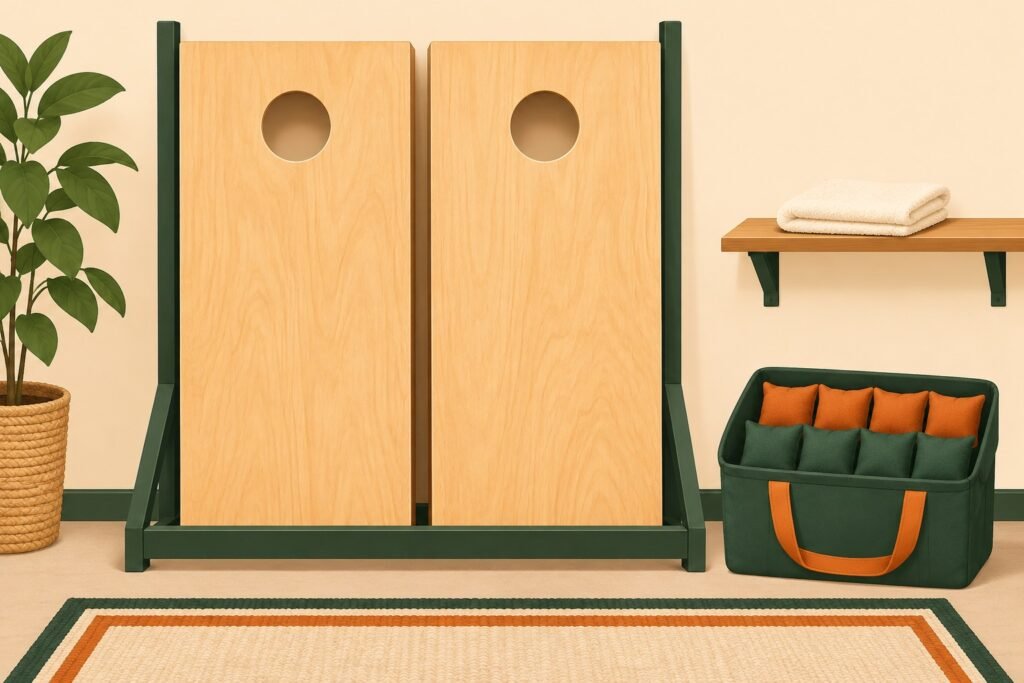
Choose a winter storage location and support arrangement that suit the actual cornhole equipment, rather than assuming that any garage, cover or rack provides the same protection. The American Cornhole Association’s winter guidance favors a dry, climate-controlled area and warns against damp locations and large environmental swings. Waffle Games buyers should assess their own storage room and the instructions for the selected construction. A room’s name does not establish its conditions, and a carry case does not establish the conditions inside it. Keep equipment identifiable and accessible for inspection, with a support arrangement appropriate to its size and weight. Follow the manufacturer’s direction on orientation, restraint and permitted loads; do not turn an illustration of upright storage into a universal rule for every model. The aim is a practical storage plan that the venue can actually maintain throughout the closed season.
The ACA winter storage article provides general location and organization guidance. Its accessory examples do not prove that another manufacturer’s rack, cover or board has the same suitability.
- Identify the location. Record the room and assigned storage position so equipment can be found and checked.
- Check the support. Confirm the rack or other arrangement is intended for the equipment being stored and follow its loading instructions.
- Keep access clear. Leave a practical way to inspect and retrieve each set without dragging other equipment across a playing surface.
- Keep status visible. Separate ready equipment from items awaiting cleaning, repair advice or missing components.
How should bags, carry cases and accessories be managed?
Manage cornhole bags, carry cases and accessories as identified components, not as interchangeable items collected into the nearest container. A Waffle Games board-only order and a complete game set can have different contents, so the accepted product specification should define the checklist. Count the actual bags and accessories, identify anything missing and record which items belong together. Use the selected bag manufacturer’s cleaning and drying instructions rather than transferring a wash cycle from a different shell or filler. The cornhole bag filling guide explains why a filler description does not establish all the properties of the finished bag. Apply the same discipline to cases and protective covers: their presence does not prove permanent outdoor suitability. Keep component records useful to the next employee who will prepare the equipment, especially when a rental fleet contains several versions with similar colors or branding.
A component checklist should name the item, expected quantity, set identifier and any distinguishing feature needed to avoid a mix-up. Include the carrying container itself if it is part of the handover. When a bag or accessory is removed for attention, record its status against the set instead of silently replacing it with a different configuration.
Keep any LED or other electrical accessory’s instructions with that accessory and follow the supplied storage directions. This guide does not prescribe battery handling, replacement electrical parts or washing methods for unidentified products. If the relevant instructions are missing, obtain them before assigning staff a maintenance procedure.
What should happen before equipment returns to service?
Before a stored cornhole set returns to service, repeat the checks needed to establish its identity, contents and accepted condition. A winter-storage label is a record of the last action, not proof that the equipment is ready for a new booking. Waffle Games operators should review unresolved observations, inspect the selected board assembly and confirm that the correct accessories are present. Open and set up the equipment according to its instructions, then compare its condition with the accepted record. If a component, finish or configuration has changed, record that change and resolve its implications before release. Keep commercial replenishment separate from an immediate maintenance decision: ordering a new set does not make a damaged set ready today. A named person should close the checklist, so the venue has a clear handover instead of relying on the assumption that someone else already checked it.
- Reconcile the record. Match the equipment identifier and close or carry forward each unresolved observation explicitly.
- Check the setup. Inspect the face, edges, supporting assembly and hardware under the product’s instructions; do not improvise acceptance limits.
- Count and identify contents. Confirm the actual board, bag and accessory configuration for the booking.
- Record release. Note the date, person and any agreed restrictions. Keep equipment awaiting a decision out of the ready allocation.
If replenishment is needed, Waffle Games’ standard minimum order is 100 sets. Samples take 5–7 days after the customer confirms proceeding with sampling; production takes 25–40 days, depending on order quantity. These are not replacement-part stock promises or delivered arrival dates. Confirm the actual item and shipping requirements in the quotation.
Browse the cornhole boards category and identify the relevant classic all-wood board configuration before sending a care-documentation or replenishment inquiry. Include the product link and explain whether the question concerns care instructions, a replacement component or a new set.
Cornhole board care and storage: common questions
Useful cornhole care questions identify the product, its finish and the intended storage conditions before selecting a treatment. The American Cornhole Association offers general maintenance guidance, while a Waffle Games order specification identifies what was supplied for a particular configuration. Neither a generic winter-storage illustration nor a photograph of a covered board establishes the instructions for every product. Rental and hotel teams should keep their actual care information with the equipment and record unresolved questions for the responsible person. The answers below summarize the practical boundaries of this guide: protection during handling is different from a storage guarantee, cleaning depends on the surface, and a return-to-service decision needs a fresh check. When those details are unclear, describe the product and observation accurately rather than borrowing a procedure from an unrelated model. Keep any clarification with the record used by the next shift.
Can wooden cornhole boards stay outside all winter under a cover?
Do not assume a cover makes permanent outdoor storage suitable. Follow the selected board’s written instructions and use an appropriate dry indoor location. A cover or carry bag alone does not establish protection for the complete assembly throughout winter.
Can unfinished cornhole boards be cleaned like clear-coated boards?
Do not automatically use the same method. Identify the finish and obtain care guidance for the actual configuration before applying water or cleaning products. Keep cleaning separate from sanding, refinishing or repairing a surface.
Is it better to store cornhole boards flat or upright?
Use the orientation and support arrangement specified for the board and storage equipment. Follow loading and restraint instructions, keep access available and avoid inventing a universal orientation rule for every construction. An upright concept illustration is not a rack design or loading specification.
Sources: ACA Care & Maintenance; ACA Winter Storage. For construction differences, see our cornhole board materials guide. Sources reviewed November 6, 2026. The operational checklists here are suggested record formats, not a claim of a particular factory inspection program.